// DARK FACTORY — LEVEL 5

Intent in. Production software out.

The autonomous pipeline that turns natural language into verified, deployed code. No code review. No manual QA. No human in the loop during execution.

TASK TYPES5
PIPELINEScode / epic / deep-plan / infra-plan / infra
HUMAN GATES1(spec approval)
01spec
>
02build
>
03verify
>
04deploy
>
05prod check
>
06shipped
convergence loop: verify fails → rebuild → re-verify → until satisfied or ceiling hit

You post a task on the BeastMode Board. BeastMode picks it up, writes a spec, designs holdout scenarios, implements the code, verifies it with Playwright browser automation, opens a PR, auto-reviews it, merges, deploys to AWS, verifies production with screenshots as proof, and auto-rolls back on failure — all without human intervention. The only human touchpoint is approving the spec before implementation begins.

BeastMode replaces the entire software development process — not individual developers. Instead of AI actors mimicking a human team (PM writes spec, dev writes code, QA reviews), BeastMode runs a staged pipeline with a convergence loop. Code quality isn't judged by reviewers — it's measured by whether the software satisfies holdout scenarios that the coders never see.
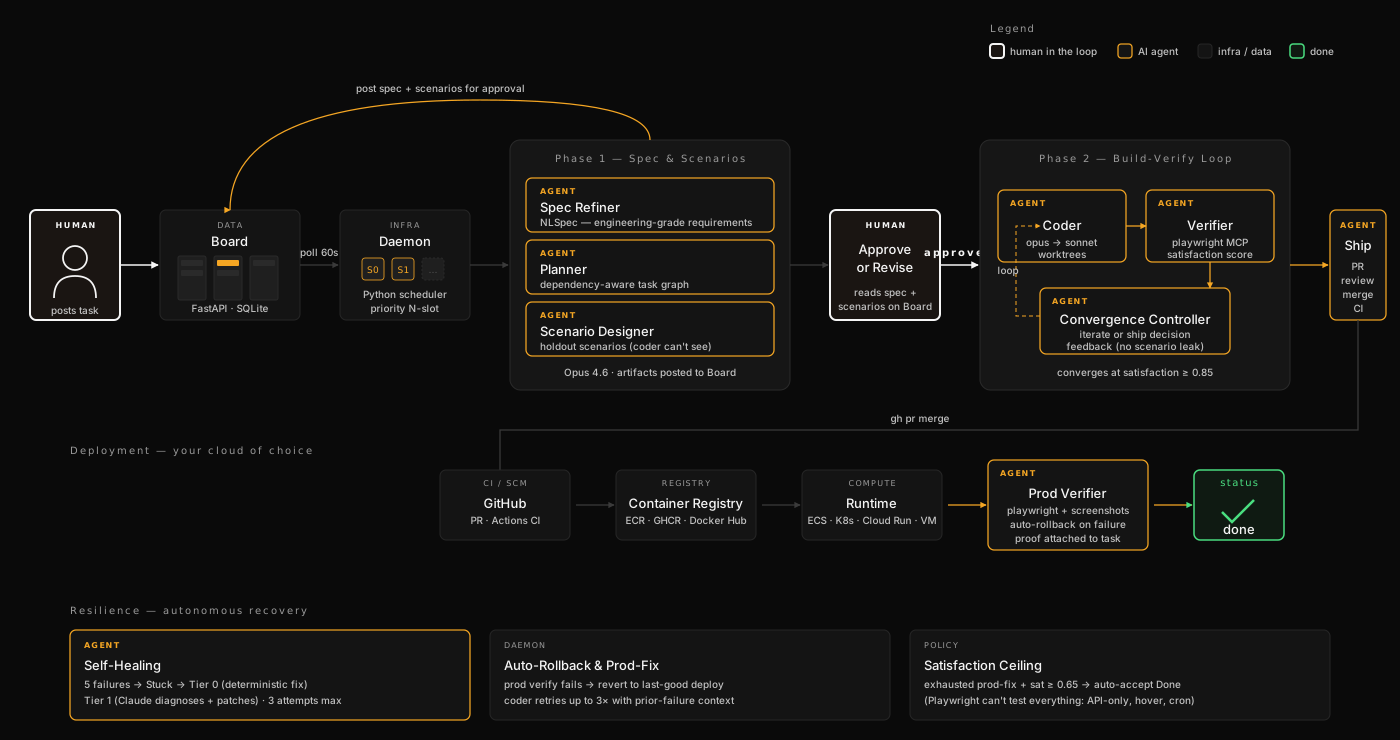
BeastMode architecture — pipeline from board to production
code (default)
Full pipeline: spec → build → ship → deploy
epic
Epic decomposition → ordered stories
deep-planning
Iterative Q&A → comprehensive decomposition
infra-plan
Infrastructure planning → sub-tasks
infrastructure
Terraform apply + verification
# clone + configure git clone https://github.com/giladneiger/beastmode.git cd beastmode cp .env.example .env # edit with your API keys + project path # run docker compose up # Open http://localhost:8420 for the board UI # Create a task → BeastMode picks it up automatically
LEVEL 4
LEVEL 5 — BEASTMODE
Code review by AI reviewer
Scenario-based verification
Tests pass/fail (boolean)
Satisfaction metrics (0.0–1.0)
Build once, review, ship
Convergence loop until satisfied
Manual failure recovery
Tiered self-healing + auto-rollback
Session-bound, human at terminal
Daemon on EC2, async via board
Single repo
Multi-repo: app, infra, GitOps, pipeline
Sequential task execution
Dynamic N-slot concurrency
Restart daemon to change config
Hot config reload
No visual proof
Playwright screenshots as proof
Depends on external project mgmt
Built-in task board, zero dependencies
Information barrier architecture
Convergence loop with probabilistic satisfaction
Tiered self-healing (0 tokens → Claude-assisted)
Epic orchestration with approval cascading
Database migration safety gate
Fail-fast on low satisfaction (< 0.3)
Haiku pre-check before expensive verifier
Self-hosted GitHub Actions runner
Auto-rollback on production failure